-

ceciliaangelica926-07e2ac ha publicado una actualización
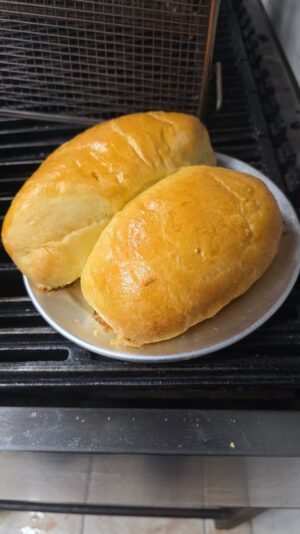
Se arrugaron cuando se enfriaron

 Réka Horváth yJohnny Jesús Mendoza2 Comentarios
-

¡Hola, Cecilia! ¡Bienvenida a la comunidad! ¡Qué bonita forma de compartir tu trabajo! No sé si has publicado esto para pedir opiniones a los demás sobre cómo explicar ese comportamiento al enfriarse, pero se me ocurren algunas ideas que creo que podría ser útil compartir (¡aunque quizá ya hayas pensado en ellas!).
¿Esto es del curso de Hans Ovando sobre brioche y croissant? Si es así, en mi opinión, este encogimiento puede deberse a que no se haya horneado lo suficiente. (Si la estructura del producto aún no está completamente cocida, el aire caliente del brioche se enfría y, como ese aire había «hinchado» el brioche anteriormente, la estructura se comprime y aparecen arrugas). La razón por la que mide la temperatura en la receta es porque quiere alcanzar el nivel adecuado de gelatinizacion de los almidones sin que el brioche se seque, de modo que siga estando jugoso. Así que creo que busca la temperatura en la que finaliza la gelatinizacion. Por lo tanto, supongo que si quisieras solucionar el problema, hay algunas cosas en las que pensar.
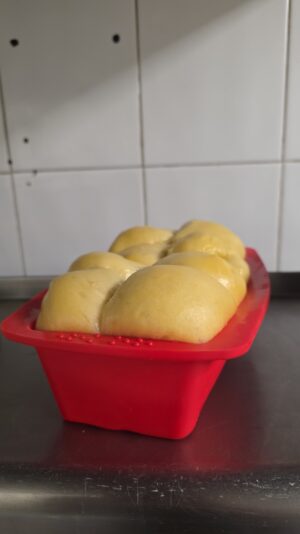
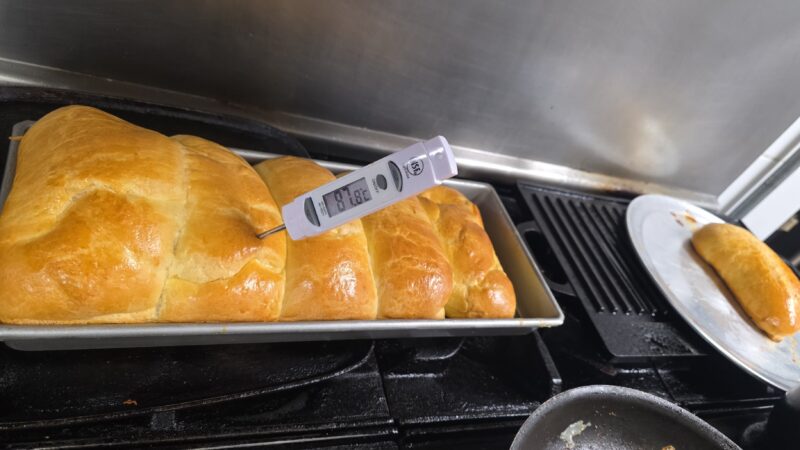
1) ¿Confías en tu termómetro, que marca 87,5 grados Celsius, y en que el brioche se haya horneado de manera uniforme (es decir, en que el horno tenga la temperatura correcta y caliente de manera uniforme)? Por supuesto, en tu foto no veo cómo estaba antes de hornearse el brioche del que has medido la temperatura, pero veo que, por un lado, parece ser un trozo más grande que los demás. Esto puede deberse a la forma de preparación o a que el calor del horno no era uniforme. Los que parecen más pequeños, ¿también se arrugaron? (Supongo que quizá tengas un horno de convección, a juzgar por el fondo de la foto, y que el profesor también lo tenga, lo cual está muy bien, aunque no estoy 100 % seguro).
2) ¿Cuál es la composición de tu harina? No creo que él especifique realmente cuál utiliza, solo da un rango de lo que se considera harina fuerte, pero creo que, desde el punto de vista de la gelatinización, el tiempo necesario, por ejemplo, puede variar un poco en función de tu composición.
Espero que esto te sirva de ayuda en cierta medida. Para una primera prueba, sospecharía que tu termómetro de varilla no es del todo preciso: los almidones de trigo suelen gelatinizarse hasta los 85 grados Celsius y esto puede variar debido a otros ingredientes, como el azúcar, por ejemplo. Así que, si, por ejemplo, tu termómetro marca una temperatura más alta de la que realmente hay, esto puede ser un problema. ¡Aunque puede que me equivoque!
Hi Cecilia! Welcome to the community, and this is such a nice way of sharing your work! I am not sure if you posted to gain some input from others at explaining the behaviour when cooling, but I have a few thoughts, which I thought it may be useful to share (though you may have gone over these points already!).
Is this from Hans Ovando’s course on brioche and croissant? If so, in my opinion, this shrivelling can be because of a slight undercook. (If the structure of the product is not completely baked yet, then the hot air in the brioche cools down, and because that “blew up” the brioche previously, then the structure compresses and you get crinkles.) The reason why he is measuring temperature in the recipe is because he wants to reach the right level of gelatinisation of starches but not dry out the brioche, so it is still moist. So I think he is looking for the temperature when the gelatinisation ends. Therefore, I suppose if you wanted to troubleshoot there are a few things to think about.
1) Do you trust your thermometer which shows the 87.5 Celsius and that the brioche is uniformly baked (as in whether the oven does have the right temperature and heats uniformly)? Of course, I don’t see in your picture how the one for which you measured the temperature, looked like before baking, but I see that on one side the brioche looks like to be a bigger piece than the others. This can either be the result of the way of preparation or that the oven’s heat was not uniform. The ones that look smaller, did they crinkle up as well? (I suppose you may be having a convection oven based on the background of the picture and so does the instructor, so that’s great, though I am not 100% sure.)
2) What is your flour composition? He is not really saying I think which he uses, just a range for what is appropriate as strong flour, but I think from the POV of gelatinisation, the required time, for example, can be a bit different based on what is your composition.
Hope this helps to any extent. For first shoot I think I would suspect that your stick thermometer is not quite right – wheat starches gelatinise usually up to 85 Celsius and it can be because of other ingredients, like sugar, for example, that this changes. So if, say, your thermometer gives you higher temperature than what really is present, this can be an issue. I may be wrong though!
hace una semanaTraducido del inglés
-
HOla, también puede deberse a la sobrefermentación o debilitamiento del gluten / estructura: Una masa pasada de fermentación o con gluten debilitado (por exceso de tiempo, acidez alta o enzimas muy activas) desarrolla una red poco elástica. Infla en el horno por expansión térmica, pero no sostiene el volumen al enfriarse y se arruga.
Pueden ser muchas cosas, entre las que Reka te ha indicado.
No sé qué masa has preparado, pero en el caso de exceso de humedad en la fórmula o ingredientes muy húmedos puede pasarte también. Me refiero a masas de alta hidratación, con purés, frutas, verduras, lácteos, grasas o azúcares (que retienen agua y ablandan la corteza) tienen mayor tendencia a arrugarse si no se compensa con buena cocción y ventilación al enfriar.
-