-

ceciliaangelica926-07e2ac posted an update
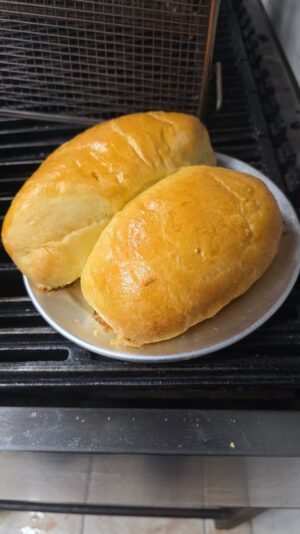
They shriveled up when they cooled down
Se arrugaron cuando se enfriaron
 Translated from Spanish
 Réka Horváth and Johnny Jesús Mendoza2 Comments
-

Hi Cecilia! Welcome to the community, and this is such a nice way of sharing your work! I am not sure if you posted to gain some input from others at explaining the behaviour when cooling, but I have a few thoughts, which I thought it may be useful to share (though you may have gone over these points already!).
Is this from Hans Ovando’s course on brioche and croissant? If so, in my opinion, this shrivelling can be because of a slight undercook. (If the structure of the product is not completely baked yet, then the hot air in the brioche cools down, and because that “blew up” the brioche previously, then the structure compresses and you get crinkles.) The reason why he is measuring temperature in the recipe is because he wants to reach the right level of gelatinisation of starches but not dry out the brioche, so it is still moist. So I think he is looking for the temperature when the gelatinisation ends. Therefore, I suppose if you wanted to troubleshoot there are a few things to think about.
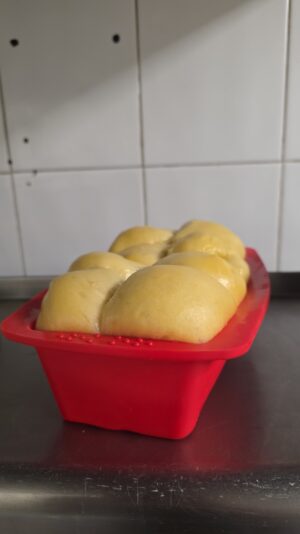
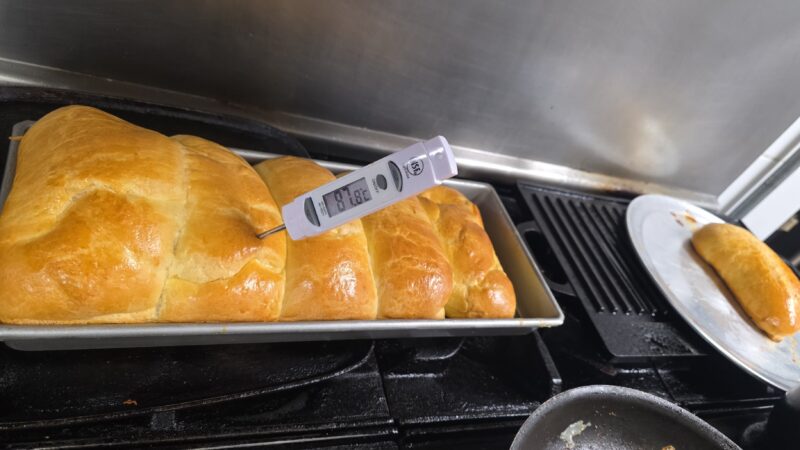
1) Do you trust your thermometer which shows the 87.5 Celsius and that the brioche is uniformly baked (as in whether the oven does have the right temperature and heats uniformly)? Of course, I don’t see in your picture how the one for which you measured the temperature, looked like before baking, but I see that on one side the brioche looks like to be a bigger piece than the others. This can either be the result of the way of preparation or that the oven’s heat was not uniform. The ones that look smaller, did they crinkle up as well? (I suppose you may be having a convection oven based on the background of the picture and so does the instructor, so that’s great, though I am not 100% sure.)
2) What is your flour composition? He is not really saying I think which he uses, just a range for what is appropriate as strong flour, but I think from the POV of gelatinisation, the required time, for example, can be a bit different based on what is your composition.
Hope this helps to any extent. For first shoot I think I would suspect that your stick thermometer is not quite right – wheat starches gelatinise usually up to 85 Celsius and it can be because of other ingredients, like sugar, for example, that this changes. So if, say, your thermometer gives you higher temperature than what really is present, this can be an issue. I may be wrong though!
-
Hi, it could also be due to overfermentation or a weakened gluten structure: Dough that has fermented too long or has weakened gluten (due to excessive time, high acidity, or highly active enzymes) develops a less elastic network. It rises in the oven due to thermal expansion, but it doesn’t hold its volume as it cools and ends up shriveling.
There could be many reasons, including the ones Reka mentioned.
I don’t know what kind of dough you made, but this can also happen if there’s too much moisture in the recipe or if you use very moist ingredients. I’m referring to high-hydration doughs containing purées, fruits, vegetables, dairy products, fats, or sugars (which retain water and soften the crust); these are more prone to shrinking if not compensated for by proper baking and ventilation as they cool.HOla, también puede deberse a la sobrefermentación o debilitamiento del gluten / estructura: Una masa pasada de fermentación o con gluten debilitado (por exceso de tiempo, acidez alta o enzimas muy activas) desarrolla una red poco elástica. Infla en el horno por expansión térmica, pero no sostiene el volumen al enfriarse y se arruga.
Pueden ser muchas cosas, entre las que Reka te ha indicado.
No sé qué masa has preparado, pero en el caso de exceso de humedad en la fórmula o ingredientes muy húmedos puede pasarte también. Me refiero a masas de alta hidratación, con purés, frutas, verduras, lácteos, grasas o azúcares (que retienen agua y ablandan la corteza) tienen mayor tendencia a arrugarse si no se compensa con buena cocción y ventilación al enfriar.an hour agoTranslated from Spanish
-