-


Heloísa Paço Moreira posted an update in the club
2 weeks ago Pastry & Bakery
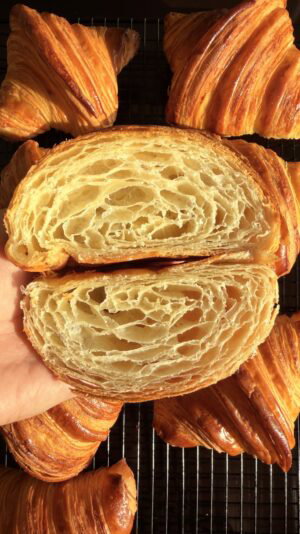
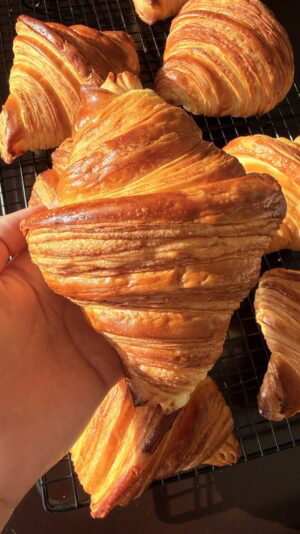
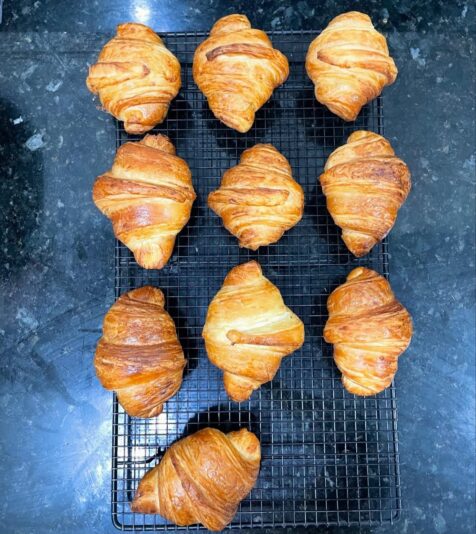
This is my 4th time making croissants. I’m completely in love with viennoiserie. I’ve taken two online croissant courses and recently bought a manual dough sheeter, so I’m going to be doing a lot of croissant testing around here. 🥰

 André Mellergardh, Roxana Forné Gasulla and 11 others11 Comments
-
Level:
 Scoolinary Team
And this is only your fourth try! 🥐 You’re clearly getting the hang of laminating. The outer layers are very well defined, the golden color is quite even, and when you look at the cross-section, you can see that open-cell structure we look for in a good croissant. The manual laminator will allow you to better control the thickness and achieve consistent results. Here’s a question for you: now that you can work with greater precision, what would you like to perfect first—the evenness of the crumb, the volume, or that crispy texture on the outside? And, out of curiosity, what’s changed the most between your first attempt and this fourth one?
Level:
Scoolinary Team
¡Y solo es tu cuarto intento! 🥐 Se nota que estás profundizando en el laminado. Las capas exteriores están muy bien definidas, el dorado es bastante uniforme y, al ver el corte, destaca ese alveolado abierto que buscamos en un buen cruasán. La laminadora manual te va a permitir controlar mejor el grosor y repetir resultados. Te lanzo una pregunta: ahora que puedes trabajar con más precisión, ¿qué te gustaría perfeccionar primero, la regularidad del alveolado, el volumen o esa textura crujiente del exterior? Y, por curiosidad, ¿qué ha cambiado más entre tu primer intento y este cuarto?
2 weeks agoTranslated from Spanish
-
@soldamiani I will second Sol’s questions as I was just about to write approximately the same as her – I find it very impressive that you got here in only four attempts as croissants and viennoiserie are incredibly challenging!
I may add though a few more things: It may be helpful to some to know which courses you have done – are we talking about Antonio Bachour’s courses, Hans Ovando’s or someone else’s?
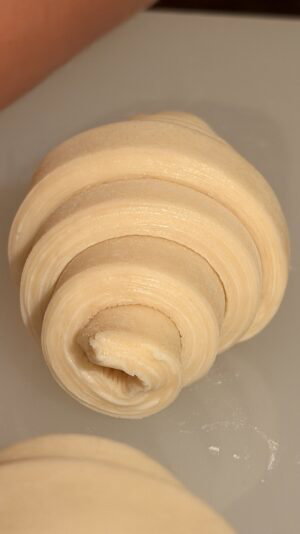
Also I am not quite a croissant expert, so can I ask if you have any ideas why for the outside look the seal part (the middle where the rolled-up triangle ends) kind of moved away from the middle? Is it a consistent thing or just showing for the one you photoed? I am quite curious if this comes from a tiny thing or whatever, because it happened to me a few times, too! 🙈
1-
@rekahorvathr-e2c3b8 Thank you very much. The two courses I took were outside this platform, they were two online courses taught by Brazilian expert instructors. I really enjoyed them because of the rich level of detail, they were great for me, as I had never had any prior experience with viennoiserie. I also plan to take the croissant courses here on the platform to improve even further.
As for the seal part (the middle where the tip of the triangle ended up shifting off-center), I’m curious about that as well. It has happened other times, though not on every single croissant. I think it might be because I didn’t roll it straight down the center, I definitely need to work on my shaping.
-
-
@soldamiani Thank you very much. First, I would like to improve the shaping and standardize the layers to at least nine visible steps/turns. I also want to achieve a more uniform crumb.
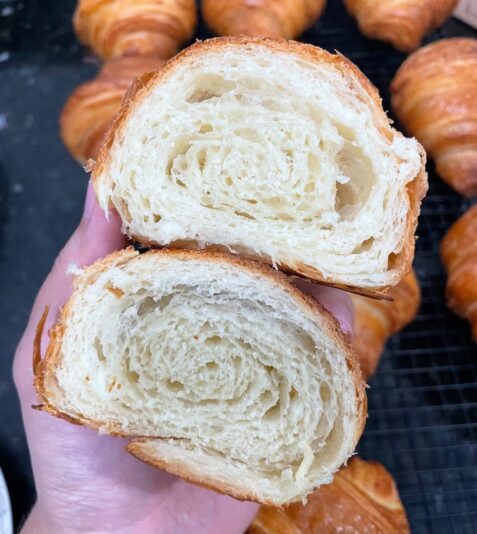
Regarding what changed from my first attempt to this fourth one: in my first batch, some croissants turned out uneven, and the open crumb (alvéoles) wasn’t consistent, I noticed that the butter melted during the lamination process in a few of them. For this fourth attempt, I constantly monitored the temperature of both the butter block and the dough to prevent that from happening again, and I also tried to control the ambient room temperature. I respected the resting times, whenever I felt the butter was starting to melt, I placed it back in the fridge for a while before starting the next fold. When the dough started fighting back and was difficult to roll out, I let it rest and relax. I’m going to attach some photos of the croissants from my first attempt. Once I manage to get a consistent shape and an even crumb, I plan to experiment with different croissant shapes.
-
Level:
Scoolinary Team
@heloisapacomoreira What stands out most is how much more intentional your process has become, Heloísa! Monitoring temperatures, respecting resting times, and recognizing when the dough needs to relax are exactly the habits that build consistency in viennoiserie. 🥐
Looking at your photos, the layers are developing, although the crumb still has some tighter areas alongside larger pockets. For your next batch, I’d focus on shaping: try keeping the same triangle dimensions, rolling with even tension, and positioning the tip underneath. That should help with consistency without changing too many variables at once.
I’m curious, have you noticed whether the off-center tips happen more often with triangles cut from a particular part of the dough sheet? That could help you distinguish between a shaping issue and uneven dough thickness. Your approach to testing is taking you in a great direction!
-
-
-
What amazing pastries! 😍😍
Qué maravilla de masas😍😍
12 weeks agoTranslated from Spanish
-
@ivasamargmail-com thank you 😍
-
-
Congratulations on your accomplishments
Felicidades por tus logros
12 weeks agoTranslated from Spanish
-
@marianela-solis4400 thank you 😊
-
-
I took two croissant-making classes. One used sourdough starter and the other was the regular method, but I haven’t been able to make them at home—the temperatures are too high, and to work with the dough, I need a fan that cools it down well, and I don’t have one yet. ;(
Yo hice dos cursos de Croissants. Uno con masa madre y otro normal, pero no he podido hacerlas en mi casa, las temperaturas son muy altas y para poder trabajarlas necesito un aire que enfríe bien y no lo tengo aún. ;(
2 weeks agoTranslated from Spanish
-
@laupet2000gmail-com On my first attempt, I also tried laminating by hand, and I found it really challenging. You have to constantly monitor the temperature of both the dough and the butter throughout the whole lamination process, whenever you notice the butter starting to melt, you have to put it in the fridge.
1
-
-