-

Réka Horváth posted an update
10 hours ago (edited)
#MeringueChallenge
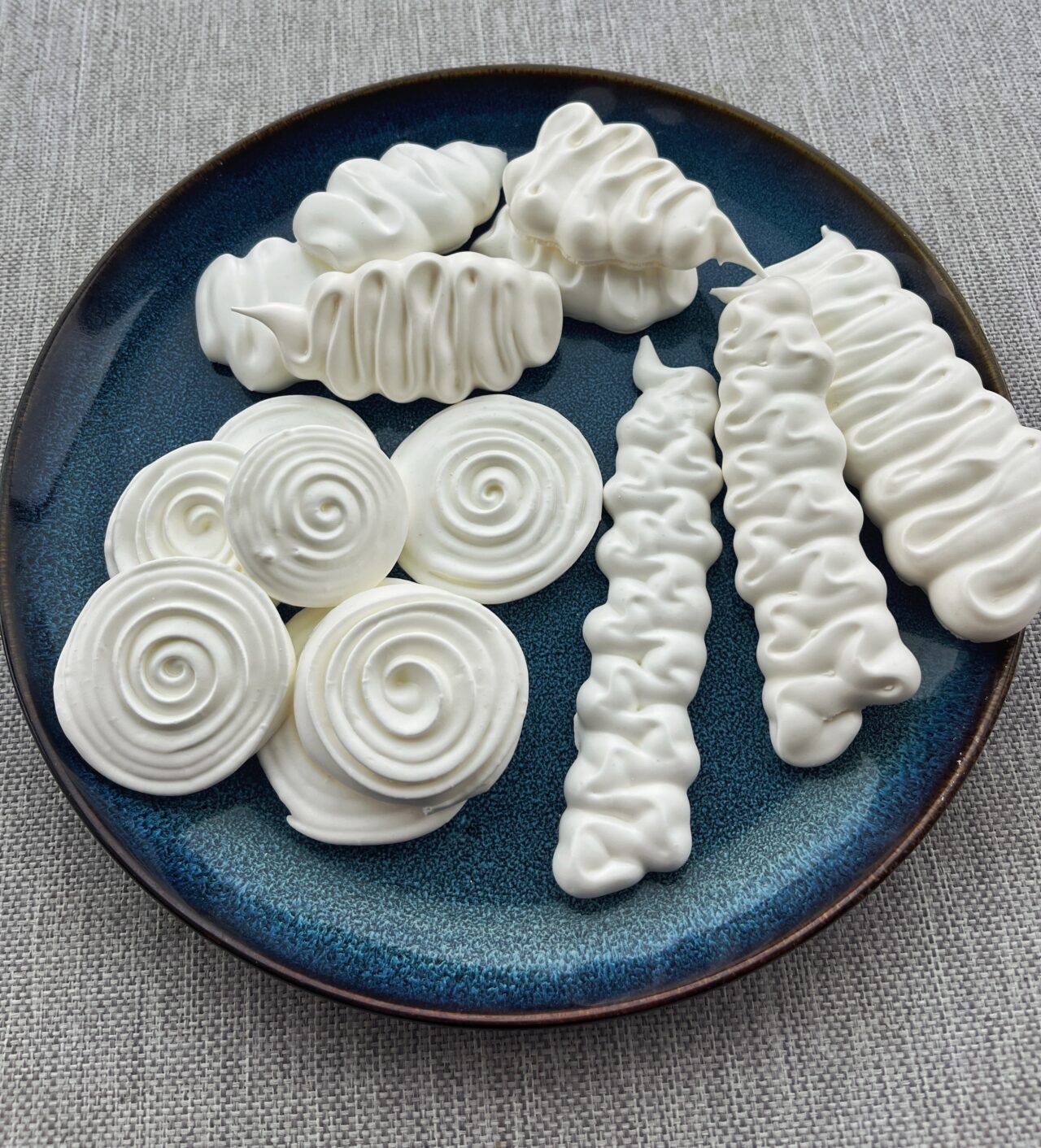
Hi All! I have finally managed to get to this. Unfortunately, electricity has been off in all sockets in my kitchen, so I decided to experiment what happens if one wants to create more elaborate petit gateaux decoration pieces out of dry French meringue (Chef Ríos recommended Swiss for these types of uses because of stability, but since I have this issue with electricity at the moment, I thought I’ll see how much harder it is to do it with French – turns out it is doable but probably not as clean and nice as it would be with a more stable option).
I have some questions that I’d like to add here (especially since I won’t be able to participate in the live session tomorrow given my lack of knowledge of Spanish language):
1) I thought that the gloss in the meringue is related to sugar mostly, and how sugar is dissolved. Why will alkaline meringues be more glossy on the whole than the acidic?
2) I often have the issue of the meringue becoming more wet looking over time when I am piping. Usually the problem happens when I either work in a hot kitchen – I have had this before with Italian meringue, too, even if I cooked to syrup alright and there were no remains of sugar syrup behind -, or in the parts which were closer to my hand in the piping bag. 🙈 Do you have any recommendations for ambient temperature when making and/or using meringue? Besides pH, does the gloss depend on temperature in any ways so that one could notice if the temperature is inappropriate?
3) For the same issue, I think it may be a pH problem at least partially, too. Even though I followed the French meringue recipe of Chef Ríos, I’ve got a quite glossy result in the end. This suggests to me that either the eggs or the lemon juice that I was using were not the same pH as it was in the ingredients in the other country/brand that she made the recipe from. If I have no pH meter and I don’t want to make very many tests with different ratios of ingredients, is there a quick way of knowing how to hit the ratios right?4) Is there a difference between the pH of an old egg/new (intact)? Does the protein strength change over time even when the egg is not opened yet? Why does this strength even change chemically speaking over time? Is this about oxidation, loss of water and hence different pH – if this applies to opened eggs only -, or something else?
Many thanks to Chef Ríos for the nice course on meringues – I suppose it should be informative to generally experienced people as well, especially for troubleshooting, and understanding processes. Highly recommend watching! 🙂

 Laura Peters de Velásquez1 Comment
-

Here’s a link that explains why the pH of an egg changes—it becomes more alkaline over time: https://www.elconfidencialdigital.com/articulo/gourmet/huevo-cambia-laying-five-processes-affect-freshness/202609181839181194008.html
te dejo algo que explica el porqué de los cambios de pH del huevo, que se alcaliniza con el tiempo https://www.elconfidencialdigital.com/articulo/gourmet/huevo-cambia-puesta-cinco-procesos-alteran-frescura/202609181839181194008.html
3 hours agoTranslated from Spanish
-