-

Antonio Salvador Moreno Carretero posted an update
Level: Executive Chef
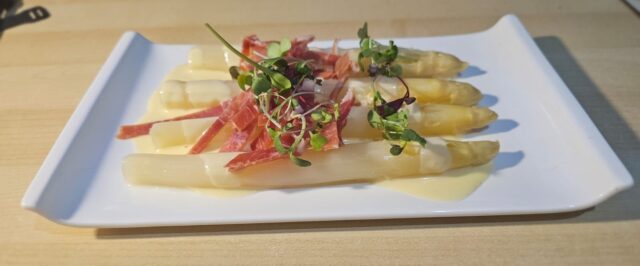
Asparagus with hollandaise sauce and Iberian ham.
A light but appetizing dinner without lighting a fire. Do you know the origin and how hollandaise sauce is made? Hollandaise sauce is an emulsion made with butter and lemon juice or vinegar, which uses egg yolks as an emulsifying agent. It is usually seasoned with salt and a little white pepper or even cayenne powder. It is a sauce of French origin whose name was given in homage to the victory of the French in the Franco-Dutch war. Hollandaise sauce is the main ingredient of eggs benedict. It is a sauce of a high degree of difficulty. To make it, clean egg yolks are diluted in cold water. It is beaten over heat in a bain-marie until a thick and frothy cream is obtained, which doubles its volume. Add the previously clarified and lukewarm butter, little by little and without stopping beating. Then add the salt, pepper and the juice of a quarter of a lemon and mix well. Sometimes it is believed that the hollandaise sauce should have a consistency similar to mayonnaise, but it should be clarified that this sauce should have a foamy consistency. It is kept at the heat of a bain-marie until it is used because it is very unstable. Ergo, it has to be served hot, because if it is left to cool it is cut. There are variants of the sauce that derive in others: Sauce maltaise (Maltese sauce). Flavored with orange juice instead of using lemon juice (or even a mixture with it). It is usually served with asparagus in traditional French cuisine. Sauce mousseline (mousseline sauce). A small amount of whipped cream is used in hollandaise sauce to lighten just before serving. Sauce noisette (noisette sauce). Butter is added to improve its flavor. Rachel sauce Taking the base of a hollandaise sauce, mustard, freshtarragon and black truffle are added. Muscovite sauce (also called caviar sauce). Based on hollandaise sauce, caviar is added. Cédard sauce. Based on hollandaise sauce, mushroom essence is added
Dijon sauce. To which mustard is added.
Level:
Executive Chef
Espárragos con salsa holandesa e ibéricos.
Una cena ligera pero apetecible y sin encender un fuego. ¿Sabéis el origen y cómo se elabora la salsa holandesa? La salsa holandesa es una emulsión elaborada con mantequilla y zumo de limón, o vinagre, que emplea yemas de huevo como agente emulsionante. Generalmente se sazonan con sal y un poco de pimienta blanca o incluso con polvo de cayena. Se trata de una salsa de origen francés cuyo nombre fue dado en homenaje a la victoria de los franceses en la guerra franco-neerlandesa. La salsa holandesa es el ingrediente principal de los huevos benedict. Es una salsa de un alto grado de dificultad. Para elaborarla, se diluyen las yemas de huevo limpias (sin restos de clara) en agua fría. Se bate sobre fuego al baño María, hasta conseguir una crema espesa y espumosa, que llegue a doblar su volumen. Se agrega la mantequilla previamente clarificada y tibia, poco a poco y sin dejar de batir. Después se añade la sal, pimienta y el zumo de un cuarto de limón y se mezcla de forma envolvente. En ocasiones se cree que la salsa holandesa debe tener una consistencia similar a la mayonesa, pero cabe aclarar que esta salsa debe tener consistencia espumosa. Se mantiene al calor de un baño María hasta su utilización por el hecho de ser muy inestable. Ergo, ha de servirse caliente, pues si se deja enfriar se corta. Existen variantes de la salsa que derivan en otras: Sauce maltaise (salsa maltesa). Saborizada con zumo de naranja en lugar de emplear el zumo de limón (o incluso una mezcla con él). Se suele servir con espárragos en la cocina tradicional francesa. Sauce mousselina (salsa muselina). Se emplea en la salsa holandesa una pequeña cantidad de nata montada para aligerar justo antes de servir. Sauce noisette (salsa noisette). Se le añade mantequilla para mejorar su sabor. Salsa Rachel Tomando la base de una salsa holandesa se añade mostaza, estragón fresco y trufa negra. Salsa moscovita (denominada también salsa de caviar). Tomando como base la salsa holandesa se añade caviar. Salsa Cédard. Tomando como partida la holandesa se añade la esencia de setas
Salsa de Dijon. A la que se añade mostaza.
 Translated from Spanish
 Eduart Stafa, L. Fernando García Barrero and 3 others4 Comments
-

Appreciate all the explanation about hollandaise sauce variations..
1 -
Level:
Executive Chef
Encantado de aportar cosas a esta comunidad.
-
Hola ! Encuentro la receta en scoolinary ?
-
Level:
Executive Chef
@jaddygonzalez SÍ. en el curso “salss clásicas” de Ignacio Barros.
1
-
-