-

Antonio Salvador Moreno Carretero posted an update
Level: Executive Chef
Antonio Machado once said: “Walker, there is no path, the path is made by walking”. And since I proposed this challenge, I’ll start.
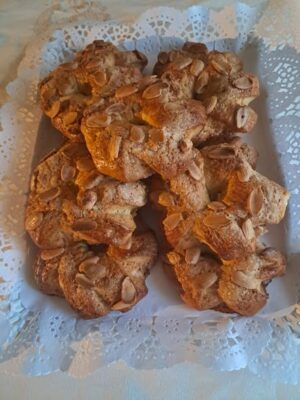
I am going to tell you about the “Rollos de naranja o de Pascua”. In the old days there were no ovens at home and the women would gather at a neighbor’s house for Christmas and make hundreds of rolls and then take them to the bakery in town to bake them and that’s where the real Christmas began. I was lucky enough to go several years with a family member to her friend’s bakery and participate in the whole process; I found it magical. As my oven is not very well suited for that, I have taken the photo and the recipe from some housewives who follow the tradition, in case anyone is up for it.
*Ingredients* Ingredients* Ingredients* Ingredients* Ingredients* Ingredients* Ingredients* Ingredients* Ingredients* Ingredients* Ingredients* Ingredients
750 g flour
250 g sugar
250 ml olive oil
100 ml orange juice
150 ml of dry aniseed
70 ml of matalahuva infusion.
Orange zest (one tablespoon)
Matalauva from the infusion (one teaspoon).
Cinnamon powder (half a teaspoon)
Pine nuts (one tablespoon)
1 sachet of baking powder
1 egg to paint the rolls.
Rolled almonds and sugar to decorate.
**Preparation
-The first thing is always to prepare ingredients and utensils.
– We make an infusion of matalahúva with 250 ml of water and 50 g of aniseed. Set aside.
– We put the flour with the yeast in a bowl or metallic pan to withstand the heat.
– Heat the oil with some orange peels.
– When the oil starts to smoke, put the peels aside and pour it, little by little, over the flour, stirring it with a wooden spoon to scald it until the oil and the flour are integrated.
-Add the grated orange zest, cinnamon, the matalauva, the pine nuts and the sugar. Stir with a spoon.
– Then add the liquids: the aniseed, the orange juice and the matalauva infusion (70 ml).
– Stir and, when the temperature of the dough allows it, knead with your hands, first in the bowl and then on the worktop.
We sprinkle a little flour on the worktop.
(The dough should be homogeneous, compact and with a rubber band)
– Cut a piece of dough and give it an elongated shape.
We cut it into pieces of about 50 g and give them a round shape (we wrap them)
– We take each piece and give it an elongated shape.
-We make 4 cuts and join the ends.
– Place the rolls on the baking tray and paint with a brush with beaten egg.
Sprinkle them with sugar and put some sliced almonds on top.
– Bake for about 20 minutes at 180 degrees with the oven preheated with heat up and down.
Level:
Executive Chef
Una vez Antonio Machado dijo: “Caminante, no hay camino, se hace camino al andar”. Y como yo propuse este reto, pues yo empiezo.
Os voy a hablar de los “Rollos de naranja o de Pascua”. Antiguamente no había hornos en casa y las mujeres se reunían por Navidades en casa de alguna vecina y elaboraban cientos de rollos y luego los llevaban a la panadería del pueblo para que se los hornearan y ahí empezaba la auténtica Navidad. Yo tuve la suerte de ir varios años con una familiar a la panadería de su amigo y participar en todo el proceso; me pareció mágico. Como mi horno no está muy para allá, he cogido la foto y la receta de unas amas de casa que siguen la tradición, por si alguien se anima.
*Ingredientes*
750 g harina
250 g de azúcar
250 ml de aceite de oliva
100 ml de zumo de naranja
150 ml de anís seco
70 ml de infusión de matalahuva.
Rayadura de naranja (una cucharada)
Matalauva de la infusión (una cucharadita).
Canela en polvo (media cucharadita)
Piñones (una cucharada)
1 sobre de levadura en polvo
1 huevo para pintar los rollos.
Almendra laminada y azúcar para decorar.
**Elaboración**
—Lo primero siempre es preparar ingredientes y utensilios.
– Hacemos una infusión de matalahúva con 250 ml de agua y 50 g de anís en grano. Reservamos.
– Ponemos la harina con la levadura en un bol o cacerola metálica para q aguante el calor.
– Calentamos el aceite con unas pieles de naranja.
– Cuando el aceite empiece a humear, apartamos las pieles y lo volcamos, poco a poco, sobre la harina, removiéndolo con una cuchara de madera para que se escalde hasta que se integre el aceite y la harina.
—Le agregamos la ralladura de la naranja, la canela, la matalauva, los piñones y el azúcar. Removemos con la cuchara.
– A continuación ponemos los líquidos: el anís, el zumo de naranja, y la infusión de matalauva (70 ml).
– Removemos y, cuando nos lo permita la temperatura de la masa, amasamos con las manos ,primero en el bol y luego sobre la encimera.
Le espolvoreamos un poco de harina a la encimera.
(Debe quedar una masa homogénea, compacta y con liga)
– Cortamos un trozo de masa y le damos forma alargada.
Lo vamos troceando en piezas de unos 50 g y les damos forma redonda (los embolamos)
– Cogemos cada pieza y le damos forma alargada.
—Le hacemos 4 cortes y unimos los extremos.
– Colocamos los rollos en la bandeja del horno y pintamos con una brocha con huevo batido.
Los espolvoreamos con azúcar y le ponemos un poco de almendra laminada por encima.
– Cocemos unos 20 minutos a 180 grados con el horno precalentado con calor arriba y abajo.
 Translated from Spanish
 Mar Calvet, Mercedes Delgado de Miguel and 5 others1 Comment
-
 Level:
Sous Chef
Level:
Sous Chef
I can almost picture that bakery and the excitement around it. Thank you for bringing that feeling here. This is such a lovely way to start the challenge. Traditions like this are pure Christmas magic and they deserve to be told as much as cooked.
-