-
Level:
 Executive Chef
Progress of the ‘Pickled Nuts’ – 3rd month
Today is the day. Today, @loles-mhotmail-com and I share the progress of our experiment, the pickled walnuts, recipe from the course ‘Introduction to pickles’ by Robert Ruiz Moreno.
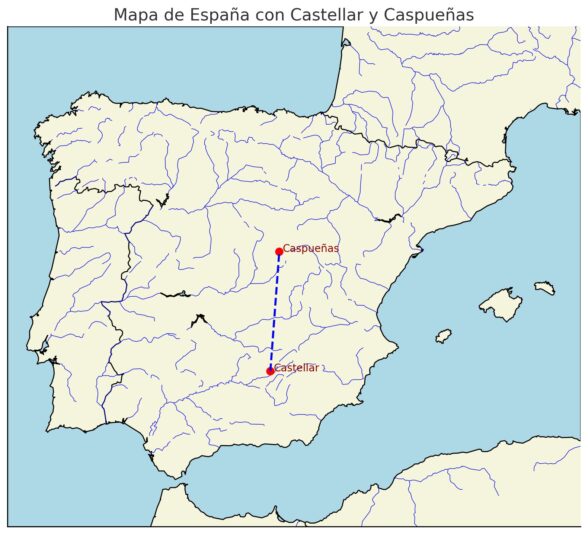
We started the experiment three months ago and decided to do the follow up with both of us, to be able to compare and see how the walnuts behave being in different places in Spain. Castellar (Jaén) and Caspueñas (Guadalajara) 272 kilometers away in a straight line (397 by road).
Three months have already passed and, for my part, this is what I observe:
Location: Caspueñas, Guadalajara, Spain
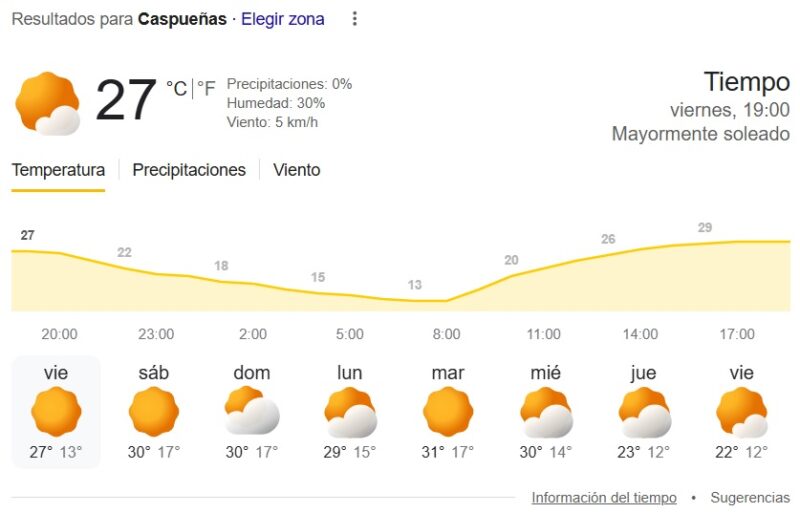
Ambient temperature: during the month we have had an average of 23°C inside the house (one day during the heat wave we have had the thermometer read 24°C), just in the room where I keep the nuts. At night, an average of 21°C. I attach the temperatures in Caspueñas today and the forecast for the next days, to give you an idea… although it must be taken into account that I don’t live exactly in the village, but two kilometers away, right in a valley, next to the river, so I have much more humidity and less temperature.
Ambient humidity: 65% (measured by a friend who has a weather station, inside the house).
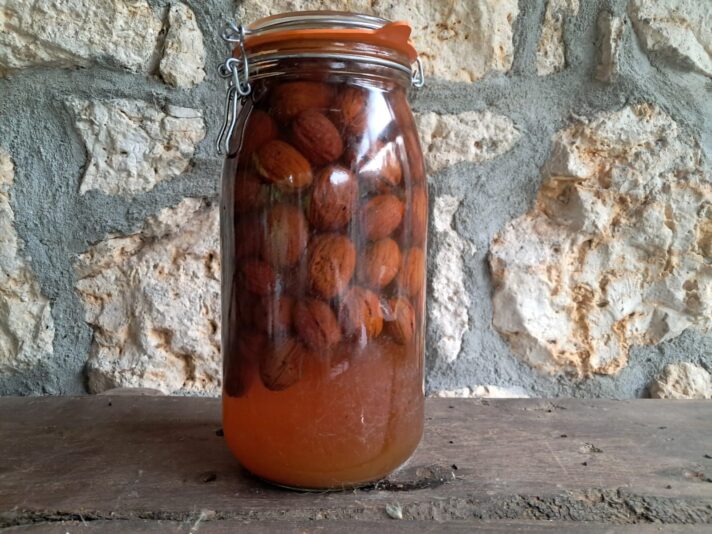
And most important of all, how do I see the nuts? Well, after 90 days, I see the dark liquid, but much less cloudy than last month. Now I see the mixture of water, sugar and vinegar with a very nice tone. (Honestly last month left me a little worried, because that turbidity did not look appetizing at all)
That it is less cloudy may have to do with the fact that, as last month I noticed that the jar was not 100% airtight, since if I moved it the lid stained a little, during this month I have not moved it at all.
On the other hand, I don’t get the feeling that the liquid level has dropped.
In his course, Robert Ruiz explains that the nuts should be pickling for a minimum of 3 or 4 months. He also says that they can be longer, up to a year (in fact in the course he shows a jar of walnuts with their liquid that has been there for more than a year). So much, I tell you, I am not going to wait to try it.
I think next month… we’ll try it and see how it goes. It is not the nuts that are used, but the liquid, to dress salads with oil, and also to make a soft drink. Once strained, it is mixed with sparkling water, or a soft drink such as soda or tonic.
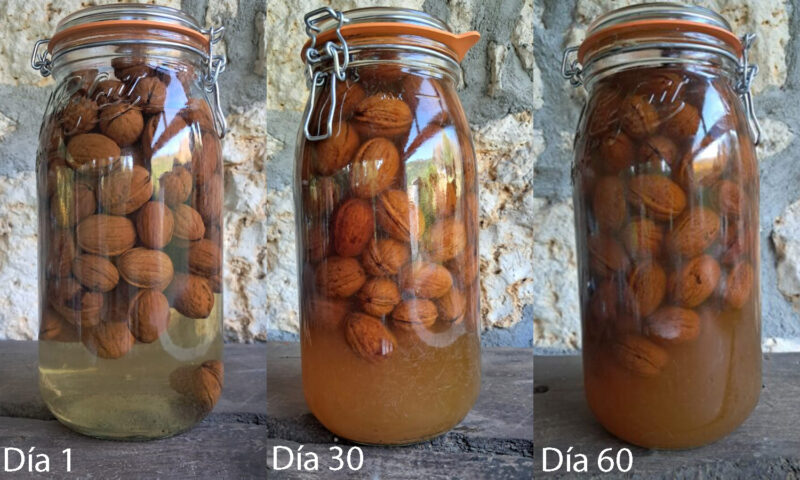
to show the evolution, we share the photo we have just taken, as well as another photo with the evolution of the nuts at the beginning and the following two months. Also the temperatures and a map so you can see where we are.
Level:
Executive Chef
Progreso de las ‘Nueces encurtidas’ | Tercer mes
Hoy es el día. Hoy, @loles-mhotmail-com y yo compartimos los avances de nuestro experimento, las nueces encurtidas, receta del curso ‘Introducción a los encurtidos’ de Robert Ruiz Moreno.
Iniciamos el experimento hace ya tres meses y decidimos hacer el seguimiento las dos, para poder comparar y ver cómo se comportan las nueces estando en diferentes lugares de España. Castellar (Jaén) y Caspueñas (Guadalajara) a 272 kilómetros de distancia en línea recta (397 por carretera).
Ya han pasado tres meses y, por mi parte, esto es lo que observo:
Lugar: Caspueñas, Guadalajara, España
Temperatura ambiental: durante el mes hemos tenido 23°C de media dentro de casa (algún día durante la ola de calor que hemos tenido el termómetro marcaba 24), justo en la estancia donde guardo las nueces. Por la noche, una media de 21°C. Os adjunto las temperaturas de Caspueñas de hoy mismo y previsión de próximos días, para que os hagáis una idea… aunque hay que tener en cuenta que no vivo exactamente en el pueblo, sino a dos kilómetros, justo en un valle, pegada al río, de manera que tengo mucha más humedad y menos temperatura.
Humedad ambiental: 65% (medido por un amigo que tiene estación meteorológica, dentro de casa).
Y lo más importante de todo, ¿cómo veo yo las nueces? Pues después de 90 días, observo el líquido oscuro, pero mucho menos turbio que el mes pasado. Ahora veo la mezcla de agua, azúcar y vinagre con un tono muy bonito. (Sinceramente el mes pasado me dejo un poco preocupada, porque esa turbidez no parecía nada apetecible)
Que esté menos turbio quizá tenga que ver con que, como el mes pasado observé que el frasco no era hermético al 100%, puesto que si lo movía la tapa manchaba un poco, durante este mes no lo he movido nada en absoluto.
Por otro lado, no me da la sensación de que haya bajado el nivel de líquido.
En su curso, Robert Ruiz explica que las nueces deben estar encurtiendo un minimo de 3 o 4 meses. También dice que pueden estar más tiempo, hasta un año (de hecho en el curso muestra un frasco de unas nueces junto con su líquido que lleva más de un año). Tanto, ya os lo digo, no voy a aguantar para probarlo.
Yo creo que el mes que viene… probaremos a ver qué tal. No son las nueces lo que se aprovecha, sino el líquido, para aliñar ensaladas junto aceite, y también para hacer un refresco. Una vez colado, se mezcla con agua con gas, o algún refresco tipo gaseosa o tónica.
Para que se vea bien la evolución, compartimos la foto que acabamos de
hacer, además de otra foto con la
evolución de las nueces al inicio y los dos meses siguientes. También las temperaturas
y un mapa para que veáis dónde estamos cada una. Translated from Spanish
 Orsolya Csernák, Mercedes Minaya Palacios and 3 others10 Comments
-
 Level:
Executive Chef
Level:
Executive Chef
But what a nice change! I agree with you that the liquid is nicer. Maybe it was because you moved it ..if you don’t have to touch it at all hahahahahah. And hey, such divine temperatures, so you feel like cooking all the time 😉.
Great, everything is going smoothly, now for the last month !!!! ❤
Level:
Executive Chef
Pero que cambio tan bueno!! Coincido contigo en que el liquido está mas bonito. Quizás fue debido a que lo moviste ..si es que no hay que tocarlo nada jaaajjaj. Y oye, menudas temperaturas tan divinas, asi tienes ganas de cocinar todo el rato 😉
Genial, todo va sobre ruedas, ahora a por el último mes !! ❤
1a year agoTranslated from Spanish
-
Level:
Executive Chef
@loles-mhotmail-com jijiji, ahora entiendes la locura que me ha dado con el reto verde 🤣
Si, dada la evolución, el frasco ni tocarlo ya, solo para ponerlo en el porche, que es donde hago la foto
1-
Level:
Executive Chef
@beatriztorijagmail-com Jajjajaja Siii, esos es!!
-
-
-
Level:
Sous Chef
Can’t wait to hear your impressions when you finally taste it next month. After three months of patience, it’ll be so satisfying to see how all that time has paid off.
1-
Level:
Executive Chef
@lanamihajlovic…Can you imagine if it’s not tasty after all? 🫠😆 Be that as it may, there’s less time left to find out!!!
Level:
Executive Chef
@lanamihajlovic …¿Te imaginas que después de todo no esté rico? 🫠😆
Sea como sea, ya queda menos para salir de dudas!!
1a year agoTranslated from Spanish
-
Level:
Sous Chef
@beatriztorijagmail-com Did you know that we also have a walnut specialty?
Orahovacha is a traditional Serbian liqueur made from young green walnuts and rakija, often enriched with spices and honey. It is known for its rich flavor and medicinal properties, and is prepared by soaking young walnuts in brandy and leaving them to rest first in the sun, and later in the shade. ☺️
I’m sure this experiment of yours will work. ❤️
-
Level:
Executive Chef
@lanamihajlovic 🤞wish!.
How interesting, I didn’t know about Orahovacha. Now I would want to try it 😅.
Level:
Executive Chef
@lanamihajlovic 🤞ojalá!.
Qué interesante, no conocía la Orahovacha. Ahora querría probarla 😅
a year agoTranslated from Spanish
-
-
-
-
Siii ya se ve más Clarita el agua!! Son más similares a las de Maloles esta vez.
1 -
Level:
Executive Chef
Veamos en qué acaba esto, si merece la pena el tiempo con el refresco.
Imagino que si, deseando que lo probéis
1-
Level:
Executive Chef
@mercedesminayapalaciosgmail-com cruzo los dedos 🤞
-
-