-

Réka Horváth posted an update
5 months ago (edited)
#BreadChallenge
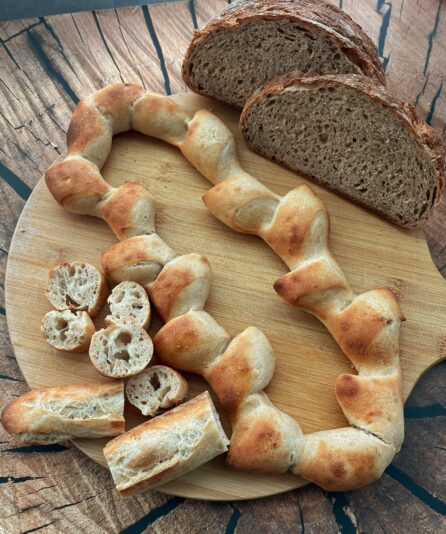
For the bread challenge, I made types of bread this weekend that I like, and organised them into a platter (see the 1st picture). I am an amateur baker.
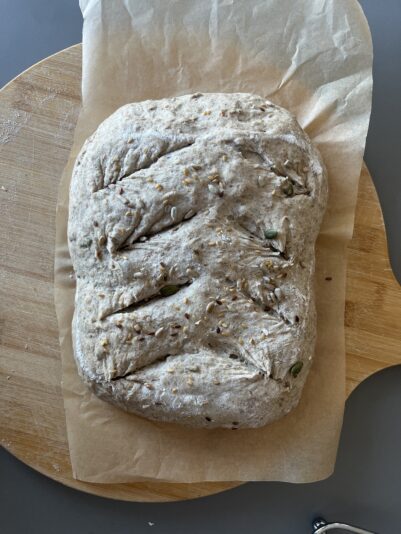
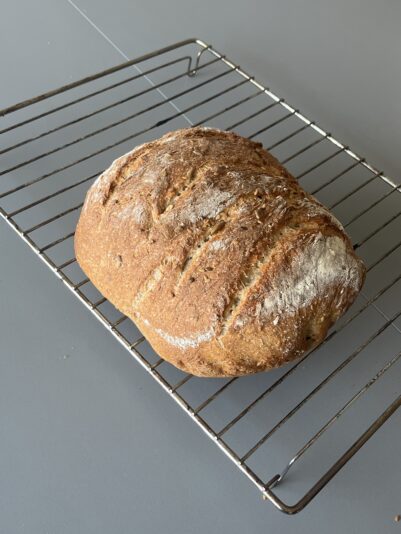
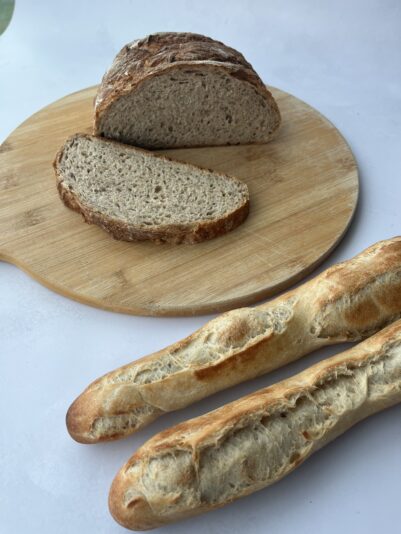
In this post, I am going to explain the first type of bread is a yeast-raised rye-based loaf, and will post another one for the baguette-types because I think otherwise the post would be too long. In the rest of the pictures I show my bread before and after baking, and the cross-cut.
The process:
Step 1: I made a preferment out of 100g of rye flour and 100 g whole-wheat flour, 130 ml water and a pinch of instant dry yeast that I kept in an airtight container for 12 hours at room temperature (around 22 °C). This serves multiple purposes at once:
- Helps the development of fermented flavour and better rise by longer fermentation.
While fermenting, yeast cells produce a variety of alcohols and other compounds that are responsible for the flavour of the bread. Longer fermentation results in more of such compounds. In addition to flavour, yeast also produces leavening gases that is helpful at the oven spring stage later on. - Pre-fermentation helps enzymatic activity that has a positive effect on the bread’s extensibility.
Making a pre-ferment allows enzymes in flour to take their effect and interfere with gluten development by weakening strands that results in a more extensible structure. In this case, it may have a more limited effect because rye flour contains a relatively small amount of gluten, but the gluten in wholemeal flour may benefit from the step. - Softening particles
Wholemeal contains the whole wheat seed, including the bran, these structures can cut through the gluten strands when mixed, hence it is advantageous to “soften” these particles in advance. Though it doesn’t eliminate the whole effect, it hydration may help (especially because too much seeds would extract water from the dough in the next steps as well which would then cause interference with the gluten development). - Products made from rye flour usually is more prone to microbiological activity
Pre-fermentation increases the level of acidity in the dough, which is an advantage in this sense.
As for water content, it is important to mention that the hydration here is around 65% which is very low for a rye-wholemeal bread given that these types absorb more water generally (this is partially because the rye flour relies on the pentosan structure that is technically a starch structure). However, in Step 2, we are going to combine the pre-ferment with wheat bread flour for better rise and less compact structure, therefore, this will not cause any problems. At this step, we will need the water more for starting the fermentation process and enzyme activity, which is possible even at a lower hydration level.
Step 2: I added 300g bread flour, 200 ml water, a teaspoon of instant dry yeast, a tablespoon of salt.
While the pre-fermentation step is more for the flavour of the bread and the flour types health advantages, this step is crucial from the point of view of the structure as my goal was to achieve a moderately open crumb while maintaining structural integrity. The vast majority of gluten will be originated from the bread flour, and with the extra water, we obtain 66% of hydration that is fairly standard for a loaf of bread, and is ideal for compactness given that later some seeds will be added as well. The final composition of having 40% rye+wholemeal flour is also ideal from the point of view that the bread therefore becomes easier to work with while still having a nice rise. The reason why we add yeast is that while in the first step, we wanted to aim mainly for flavour, here, we need to produce a reasonable amount of leavening gases, so we need more in the second. The function of the salt is strengthening the gluten structure (so it is going to be more elastic) and that it slows fermentation which makes it harder for us to overproof the bread.
Step 3: Mixing via a hand mixer with the hook attachment for 10 mins. After gluten has formed, I incorporated a few pinches of dried chilli seeds and 100 g of seed mix for additional flavour in a short mixing step.
This step aims for the development of the gluten strands (which besides hydration usually requires physical agitation), and forming a homogeneous dough. We add the seeds after gluten formation because the seeds may interfere greatly with gluten by tearing the strands.Step 4: After this, I folded the dough every 30 mins 3 times in total.
This serves the purpose of strengthening the gluten structure and redistributing gases. When folding, I also pressed the folds a little with my hands so that the distribution of air becomes more even.Step 5: After this, I fermented the bread for 1.5 hours at room temperature (24 °C approximately) to allow the yeast to aerate the dough for proper rise.
Step 6: The bread has then been shaped to be slightly rectangular and then rested for 30 mins for gluten relaxation. After that, I scored the bread which was supposed to help opening up the structure more.
Step 7: In an oven preheated to 250 °C, I baked the bread for 20 mins in a cast iron pot, closing its lid in order to keep the steam in. This is needed because in order for the bread to properly rise to its best volume, the surface should not bake the initial oven spring period, which is helped by the presence of steam which keeps the surface hydrated. After this, I removed the lid for the last 10 mins to allow the bread gain a nice, brown colour.
In the end, I think I obtained a quite nice internal structure that is slightly denser as expected but even and soft that makes one happy to eat!

 Iván Navas, Óscar J. González Hernández and 3 others1 Comment
-
 Level:
 Executive Chef
Muy orihinal
- Helps the development of fermented flavour and better rise by longer fermentation.